
Services
AI-Driven Insight & Automation
AI that works because your data is ready for it.
AI-Driven Insight & Automation
AI your team can ask, and trust
We help businesses gain comprehensive insight into their data with our AI-driven insight and automation service. That means an AI system your team can chat to in plain English, so nobody is wasting time digging through spreadsheets. It begins with the data foundation: once your data is connected and defined consistently, AI can query it, explain it, and show you what’s changed, reliably.
We make sure your data is shaped and explained in a way that AI can use to its full advantage. From natural language querying across your entire dataset to AI-driven analysis that surfaces trends, risks and correlations, we make AI practical and valuable, not theoretical.
Example
1. Ask in plain English
Which customer accounts are at risk of churning?
2. Grounded in
Your governed data
One semantic model, so every answer uses the same definitions
3. Answer, then action
3 accounts flagged, each with the reasons why.
An agent alerts the account owner
How we use AI-driven analytics
- Enhance your data schema for AI
- We build semantic models that AI can reason over, not just query. Your data gets meaning, not just structure.
- Natural language querying
- Ask questions of your data in plain English. “What were our top-performing stores last quarter?” gets a real answer, instantly.
- AI agent deployment
- We configure and deploy AI agents into your environment that can monitor, alert, and act on your business data.
See it in action
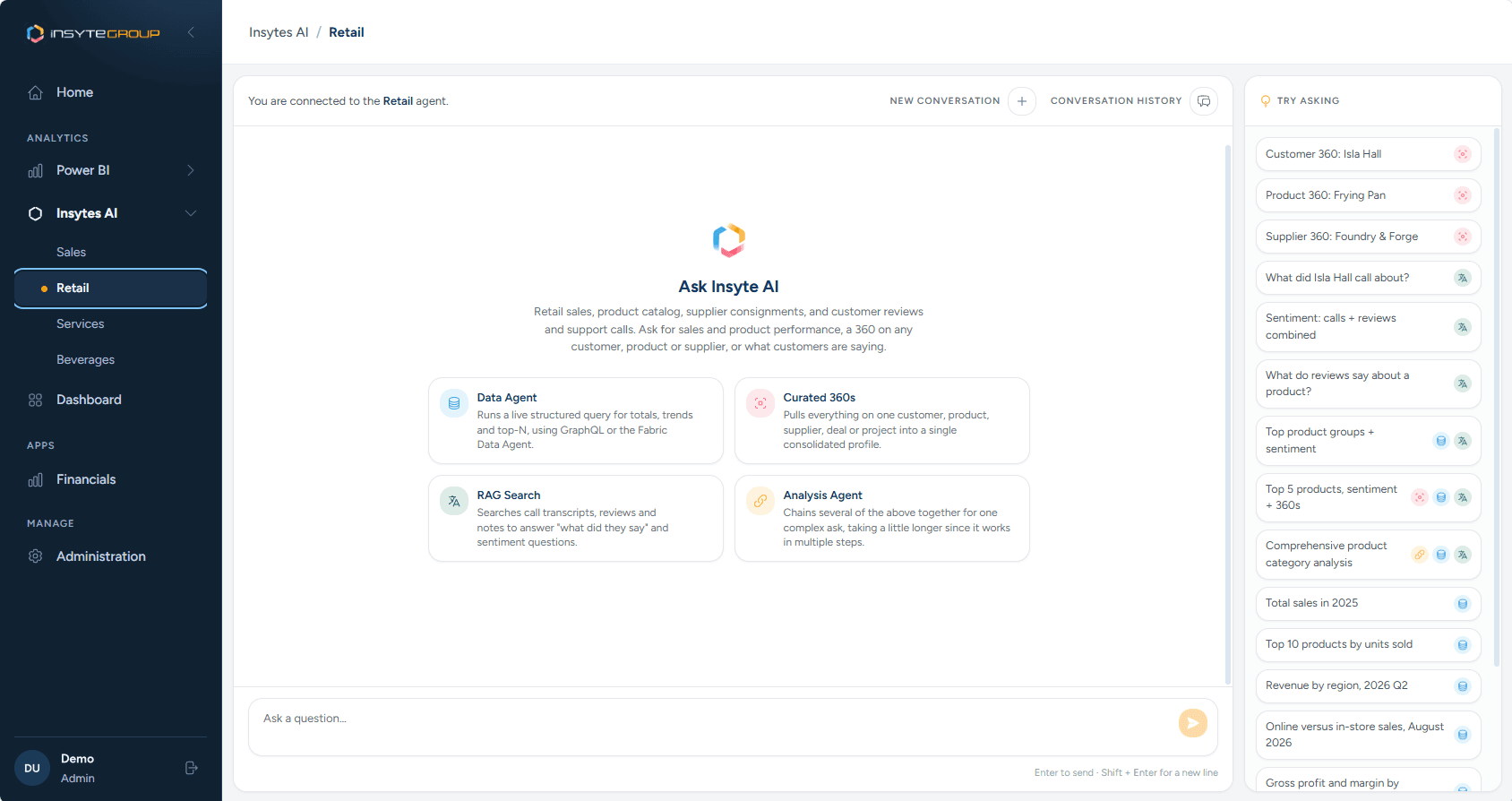
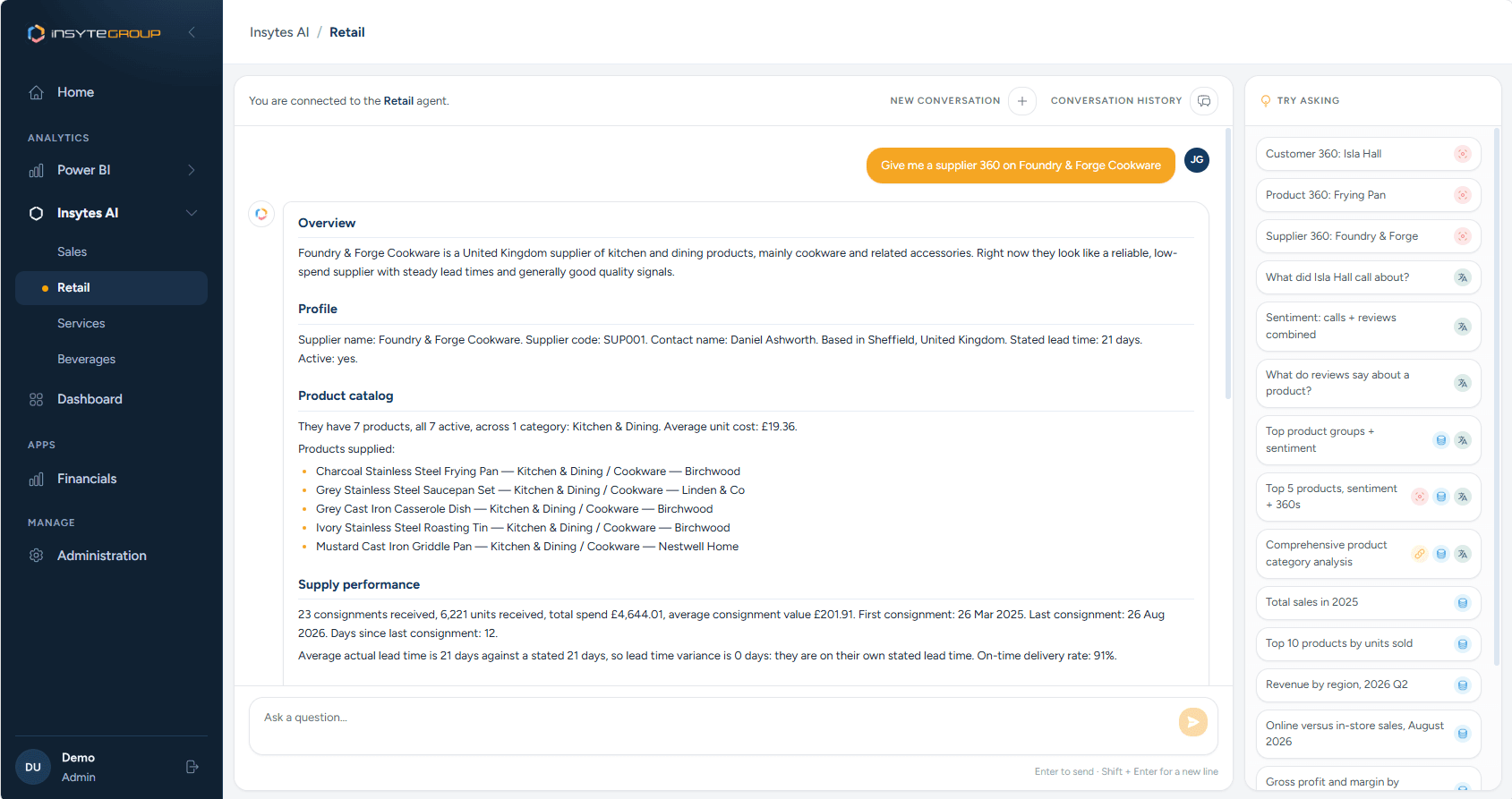
AI working on a governed data model
These screens are from our interactive experience, where you can ask questions of a working environment yourself.
Access the Insyte Experience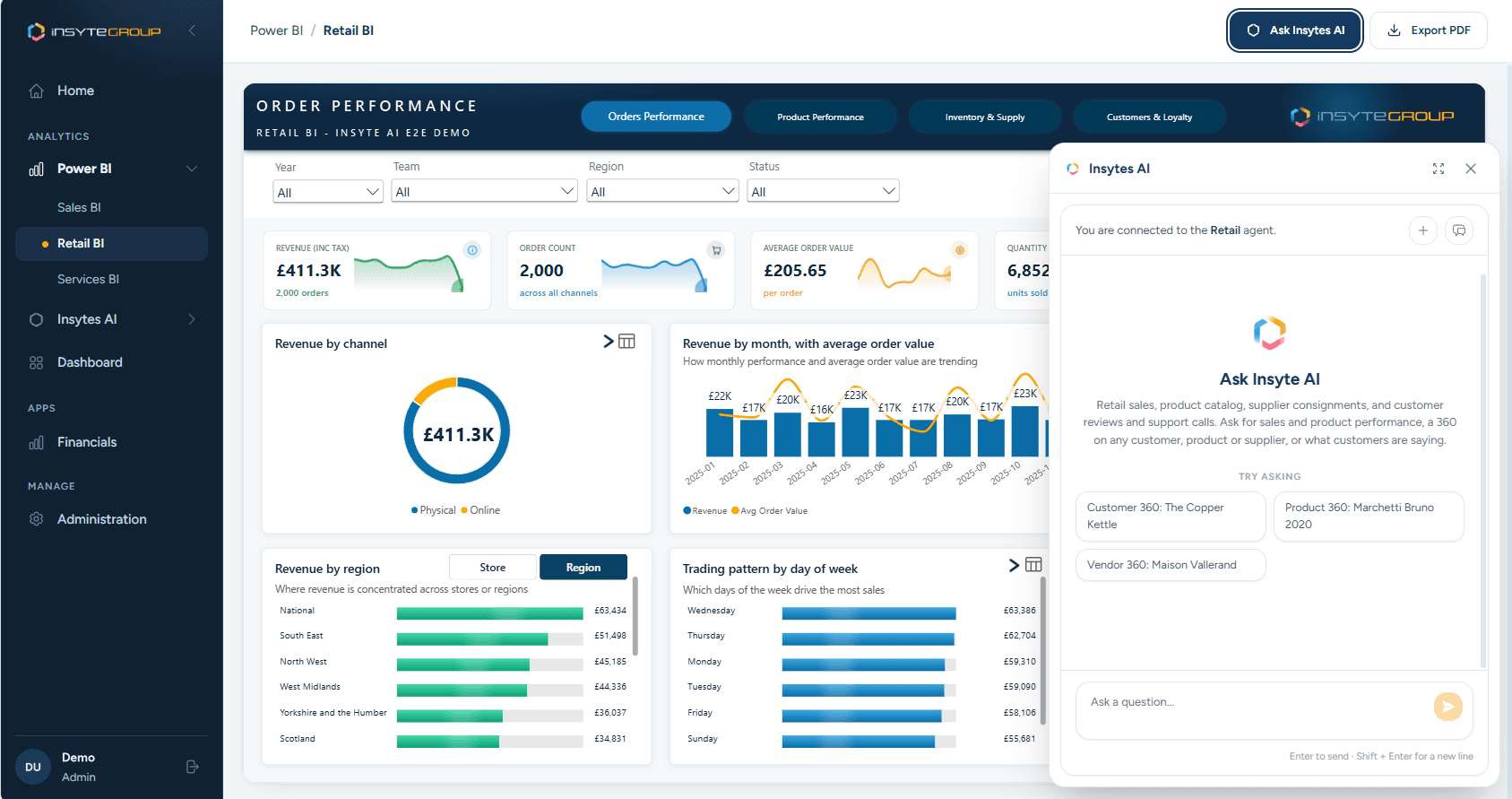
Ask Insyte AI questions about the report you are viewing
Why the foundation matters
- AI that learns from meaning, not just numbers
- By grounding ML pipelines in a semantic layer, models train on data that is consistent, labelled and contextually understood, not raw, ambiguous inputs that produce unreliable outputs.
- Unified features, no fragmentation
- A single platform harmonises data from every source into a shared representation, so feature engineering happens once and is reused across every model, team and use case.
- Scalable across teams and use cases
- Whether you’re a fast-growing business or an established enterprise, our AI search and analytics is built to scale with you, without rebuilding from scratch each time your needs evolve.
Frequently asked questions
What is AI-driven insight and automation?
AI-driven insight and automation helps businesses use artificial intelligence, machine learning and data analysis to understand performance, identify trends and make better decisions. It works best when data is clean, connected and structured, so AI tools can produce useful insights instead of unreliable or incomplete outputs.
What is the difference between business intelligence and AI?
Business intelligence (BI) uses historical data to report on what has happened. AI goes further by identifying patterns, predicting outcomes, and giving you information that standard reporting can miss. The most effective setups use both: BI and artificial intelligence solutions.
Why does AI need good data to work properly?
AI needs good data because the quality of its outputs depends on the quality of the information it learns from. If business data is fragmented, inconsistent or poorly defined, AI tools may produce inaccurate results. Clean, connected and well-structured data helps AI systems understand context and deliver more reliable insights.
How can natural language querying help businesses use their data?
Natural language querying allows users to ask questions about their data in plain English, rather than relying only on technical reports or manual analysis. This makes business intelligence more accessible to non-technical teams and helps users find answers faster across sales, finance, operations and other business areas.
What role do semantic models play in AI-powered analytics?
Semantic models give business data meaning by defining key measures, relationships and context. This helps AI systems understand what the data represents, not just where it is stored. Strong semantic models can improve the accuracy of AI-powered analytics, reporting and machine learning outputs.
How can AI agents support business decision-making?
AI agents can monitor business data, identify changes, send alerts and support faster decision-making. When connected to reliable data foundations, AI agents can help teams spot risks, trends or anomalies more proactively, reducing the need for constant manual checks and making analytics more actionable.
Other services

Data & Application Integration
Ingest your data from any source into a single location. Sync master data between your cloud applications.
Read more
Data Architecture & Engineering
Combine your data into a data lake or warehouse. Clean, harmonise, transform and aggregate. Define Semantic Models with core measures.
Read more
Interactive Dashboards & Reporting
Provide a complete picture of your business performance. Turn data into insights with interactive Power BI content.
Read more
Curious whether your data is ready for AI?
Or what it would take to get there? Let’s find out together.